
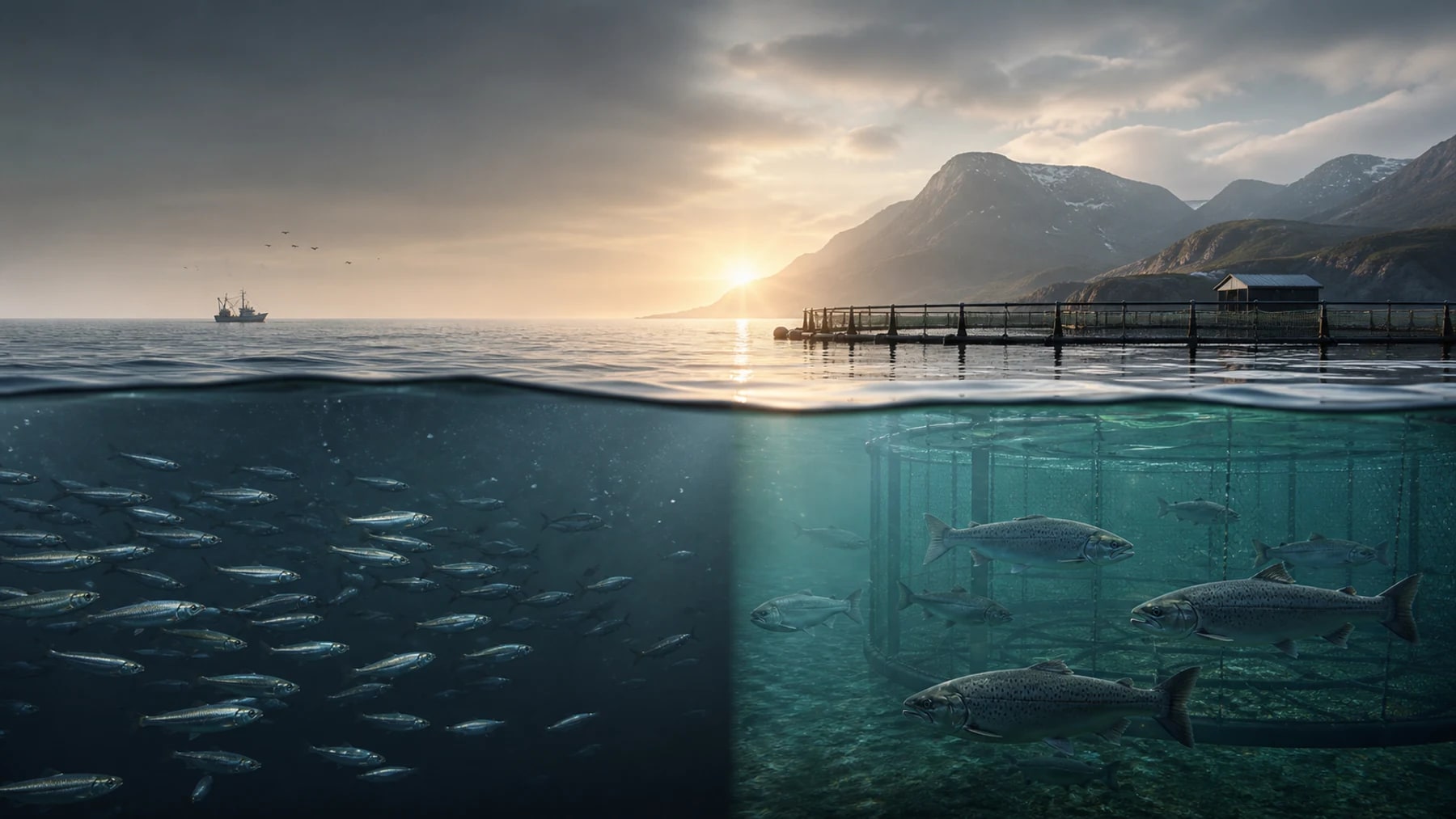
The short answer
Neither wild-caught nor farmed fish is universally better. Species, stock or farm performance, feed, fishing gear, location, season, welfare, traceability, processing and the question being asked all change the answer.
A responsibly managed wild fishery can be an excellent choice. A well-run aquaculture system can be an excellent choice. Poor performance exists in both systems, which is why a binary label is less useful than verified product-specific evidence.
The better question is not “wild or farmed?” but “which species, produced where, under what controls, and verified by whom?”
What “wild-caught” and “farmed” mean
Wild-caught fish live in marine or inland ecosystems and are harvested through fisheries. Farmed fish are raised in managed aquatic systems, including ponds, tanks, raceways, cages and recirculating systems.
Neither label describes a single environmental footprint, nutrition profile or welfare outcome. Wild fisheries range from small pelagic purse-seine operations to fuel-intensive distant-water fleets; farms range from low-input ponds to closely controlled recirculating systems.
Different routes to the table
- Wild-caughtManaged fishery
Performance depends on stock status, gear, bycatch, habitat interaction, fuel and governance.
- FarmedManaged aquatic system
Performance depends on species, feed, water, siting, health, welfare, energy and escapes.
Aquaculture is now central to the world’s seafood supply
FAO reports that aquaculture produced 103 million tonnes of aquatic animals in 2024, more than 59% of aquatic animal food output, while capture fisheries produced 92 million tonnes. Aquaculture is no longer a niche alternative; it is a primary source of food fish.
At the same time, capture fisheries remain essential to coastal economies, food cultures and species that are not commonly farmed. FAO reports that landings from biologically sustainable marine stocks represented 72.6% of assessed landings in 2023, a result that shows both progress and continuing management pressure.
Nutrition depends more on species and diet than on one label
Fish can provide protein, long-chain omega-3 fatty acids and micronutrients, but values vary by species, season, age, feed, environment and edible portion. Farmed fish can have consistent composition because feed is controlled; wild fish can reflect natural seasonal diets and movement.
EFSA concluded that available data did not show consistent differences in safety or nutritional value between wild and farmed fish. Species and the way a fish is raised or caught matter more than a universal rule.
Omega-3 is not a simple wild-versus-farmed contest
Oily wild fish can be rich in EPA and DHA. Farmed salmon can also provide substantial long-chain omega-3, but its fatty-acid profile is influenced by feed composition and has changed as the industry has reduced reliance on marine ingredients.
A product-specific declaration or current composition analysis is more reliable than assuming that every wild fish is higher or every farmed fish is lower.
Contaminants and food safety require species-level context
Mercury tends to accumulate more in larger, longer-lived predatory species. That relationship is not created by the words wild or farmed alone. Official fish-consumption advice therefore distinguishes species and population groups.
Farmed systems can control feed and monitor inputs, while wild fish reflect the environment in which they live. Both supply chains require hygiene, temperature control, residue or contaminant monitoring and accurate traceability.
Antibiotics: risk, rules and responsible use
Antimicrobial use is a legitimate concern in animal production because misuse can contribute to resistance. The European Union requires veterinary oversight, residue controls and restrictions; antibiotics cannot be used as growth promoters.
Practices differ between species, systems and jurisdictions. “Farmed” does not mean “treated with antibiotics”, and “wild” does not remove every food-safety risk. Credible assurance depends on records, surveillance and enforcement.
Feed changes the aquaculture equation
Aquaculture feed can include fishmeal and fish oil, crop ingredients, processing by-products, algae and other inputs. Feed composition affects growth, nutrition, pressure on forage fisheries and environmental footprint.
NOAA describes continued work to reduce dependence on finite marine ingredients while maintaining fish health and nutritional quality. Progress is real, but feed should not be treated as impact-free.
Environmental performance varies widely in both systems
Peer-reviewed blue-food research finds large differences within fisheries and aquaculture. Gear type, fuel use, bycatch, habitat interaction, feed conversion, energy source, water treatment and escape risk can dominate the comparison.
Small pelagic fisheries can have comparatively low greenhouse-gas emissions. Some aquaculture systems can also perform efficiently, while poorly sited or managed operations can create local impacts. A universal footprint claim would erase the variables that matter.
Variables that can change the result
- 01Wild fishery
Stock status, gear, bycatch, seabed interaction, fuel and management.
- 02Aquaculture
Feed, energy, water quality, disease, escapes, habitat and siting.
- 03Both
Species, scale, transport, processing, cold chain, labour and waste.
Welfare is part of responsible production
Farmed-fish welfare includes stocking density, water quality, handling, disease prevention, transport and slaughter. The EU continues to develop species-specific knowledge and policy in this area.
Wild-capture welfare concerns include capture duration, crowding, injury and time to stunning or death. Evidence and practical controls are still developing. Responsible comparison should acknowledge welfare rather than use it as a slogan against only one production system.
What certification can — and cannot — tell you
MSC certification assesses fisheries against a standard covering sustainable fish stocks, environmental impact and effective management. ASC standards address environmental and social performance in aquaculture supply chains.
A credible certification can improve traceability and provide structured assurance, but no logo answers every nutrition, welfare, labour or local-ecosystem question. Scope and chain-of-custody status must be checked.
How to read a product label more intelligently
Look for the species, production method where required, catch area or country of origin, processing location, ingredient list, nutrition declaration, certification scope and traceability information. Do not infer sustainability from colour, photography or the word “natural”.
For canned seafood, the commercial product may contain a wild-caught or farmed species, but sauce, oil, salt, processing and portion still shape the final food.
Choosing according to what matters to you
If biodiversity and stock status are priorities, investigate the fishery and gear. If feed, escapes or local water impacts are priorities, investigate the farm system. If nutrition is the priority, compare species and verified composition. If welfare is the priority, look for documented handling and slaughter controls.
Price, availability and cultural preference are legitimate parts of a choice. Responsible guidance should help people ask better questions, not shame them for choosing one category.
From label to evidence
- 01Species
Identify the biological species, not only the broad product name.
- 02Origin and method
Find the catch area, fishery, country or farming system.
- 03Verification
Check traceability, management evidence and relevant certification scope.
- 04Final product
Read ingredients, nutrition, portion and processing information.
The Diplomats perspective
SIA Unda works with product specifications, supplier controls, traceability and destination-market requirements. Those controls begin with the actual species and supply chain, not a marketing assumption that one production method is always superior.
The responsible position is to verify identity, origin, food safety and quality for each product, and to communicate only what the evidence supports.
A practical decision framework
First identify the species. Then examine origin, fishery or farm, management evidence, certification scope, processing, ingredients and the nutrition declaration. Finally, consider the meal, portion and your own priorities.
If essential information is absent, uncertainty is the honest conclusion. A simple front-of-pack word cannot replace traceability.
Conclusion
Wild-caught and farmed fish both contribute to the global food system. Both can perform well; both can perform poorly. The outcome depends on the details.
Choose evidence over absolutes: a known species, a traceable supply chain, credible management and a product that fits the nutritional and culinary purpose you actually have.